Why Does My Moisturizer Sting? 7 Common Reasons and What to Do
You apply a moisturizer because your face feels dry. Instead of relief, you get a sharp little sting around the nose, cheeks, or eyelids. It fades after a minute, so you wonder whether that means the product is “working.” Usually, that is not a useful way to read the signal.
When a moisturizer stings, the cause can be the formula, the condition of your skin that day, or the products used before it. A brief tingle is not always an emergency, but persistent burning, redness, swelling, or itching is a reason to stop and pay attention.
First: stinging is not proof of effectiveness
Moisturizer is meant to improve comfort and reduce water loss. It does not need to hurt to work. Some prescription products and strong actives can cause expected irritation under professional guidance, but an everyday moisturizer should not turn your routine into a tolerance test.
If the sensation is intense, wash the product off gently with lukewarm water. Do not scrub, and do not immediately cover the area with five different calming products.
1. Your skin barrier is already stressed
A formula that felt fine last month can sting after too much exfoliation, cold weather, sun exposure, repeated cleansing, or several nights of poor sleep. When the outer layer is disrupted, water escapes more easily and ingredients can reach sensitive areas faster.
Clues include tightness after washing, unusual shine with dryness underneath, rough patches, and products suddenly feeling “spicy.” Our guide to rough texture without over-exfoliating has a gentler reset plan.
2. You layered it over an active product
The moisturizer may be innocent. If it goes on top of a strong acid, retinoid, benzoyl peroxide, or prescription treatment, the sting may reflect irritation from the whole routine.
Look at the evening as one formula, not six separate purchases. Using an exfoliating toner, an acid serum, and a retinoid in one session creates more exposure than any single label suggests. If you are new to retinoids, the slower schedule in our beginner retinol guide is a safer starting point.
3. The moisturizer contains an exfoliating or treatment ingredient
Some products marketed as moisturizers also contain lactic acid, glycolic acid, salicylic acid, urea at stronger concentrations, retinoids, or vitamin C derivatives. That does not make them bad, but it changes their job.
Read the ingredient list and the directions, especially if the package promises resurfacing, peeling, clarifying, or rapid renewal. A treatment cream should not be treated like a neutral barrier cream.
4. Fragrance or aromatic extracts do not agree with you
Fragrance can make a cream enjoyable to use, but it is also unnecessary for hydration. Essential oils and aromatic plant extracts can create the same issue for some people. “Natural” does not mean non-irritating, and “clean” is not a medical safety category.
If products often sting, compare a fragrance-free formula with a shorter, familiar routine. Fragrance-free is not a guarantee, but it removes one variable.
5. You applied it to very wet or freshly exfoliated skin
Applying moisturizer to slightly damp skin can help trap water. Applying a potent product to dripping-wet skin can sometimes increase penetration and make it feel stronger. The same is true right after a scrub, cleansing brush, peel, or close facial shave.
Pat away excess water and wait until skin is calm. This is especially useful around the corners of the nose and mouth, where friction and dryness often meet.
6. The formula is old, contaminated, or stored badly
A product can change after months in a hot bathroom, direct sunlight, or an unwashed travel jar. Watch for a new smell, separated texture, color change, or a cap that has collected dried product. Check the period-after-opening symbol and expiration information when available.
Do not add water to thin an old cream. If a product has obviously changed, replacing it is cheaper than trying to prove it is still fine.
7. You may be reacting to a specific ingredient
Irritant reactions and allergic contact reactions are not the same, and it is hard to diagnose the difference from a mirror. Itching, swelling, a spreading rash, or symptoms that worsen with repeated use deserve more caution than a momentary mild tingle.
Stop the suspected product. If symptoms are severe, involve the eyes or lips, cause blistering, or do not improve, contact a qualified medical professional. Bring the package or a photo of the ingredient list.
A 72-hour routine reset
| Time | What to do | What to pause |
|---|---|---|
| Morning | Rinse or use a gentle cleanser, simple moisturizer if tolerated, sunscreen | Scrubs, acids, strong vitamin C, new serums |
| Evening | Gentle cleanse, one plain moisturizer | Retinoids, peels, masks, spot treatments |
| During the day | Avoid picking and protect skin from sun and wind | Repeated washing and fragrance sprays near the face |
This is not a treatment for a diagnosed condition. It is a short troubleshooting window that removes noise. If even a very simple moisturizer burns, or if the skin looks inflamed, seek professional advice rather than running more home experiments.
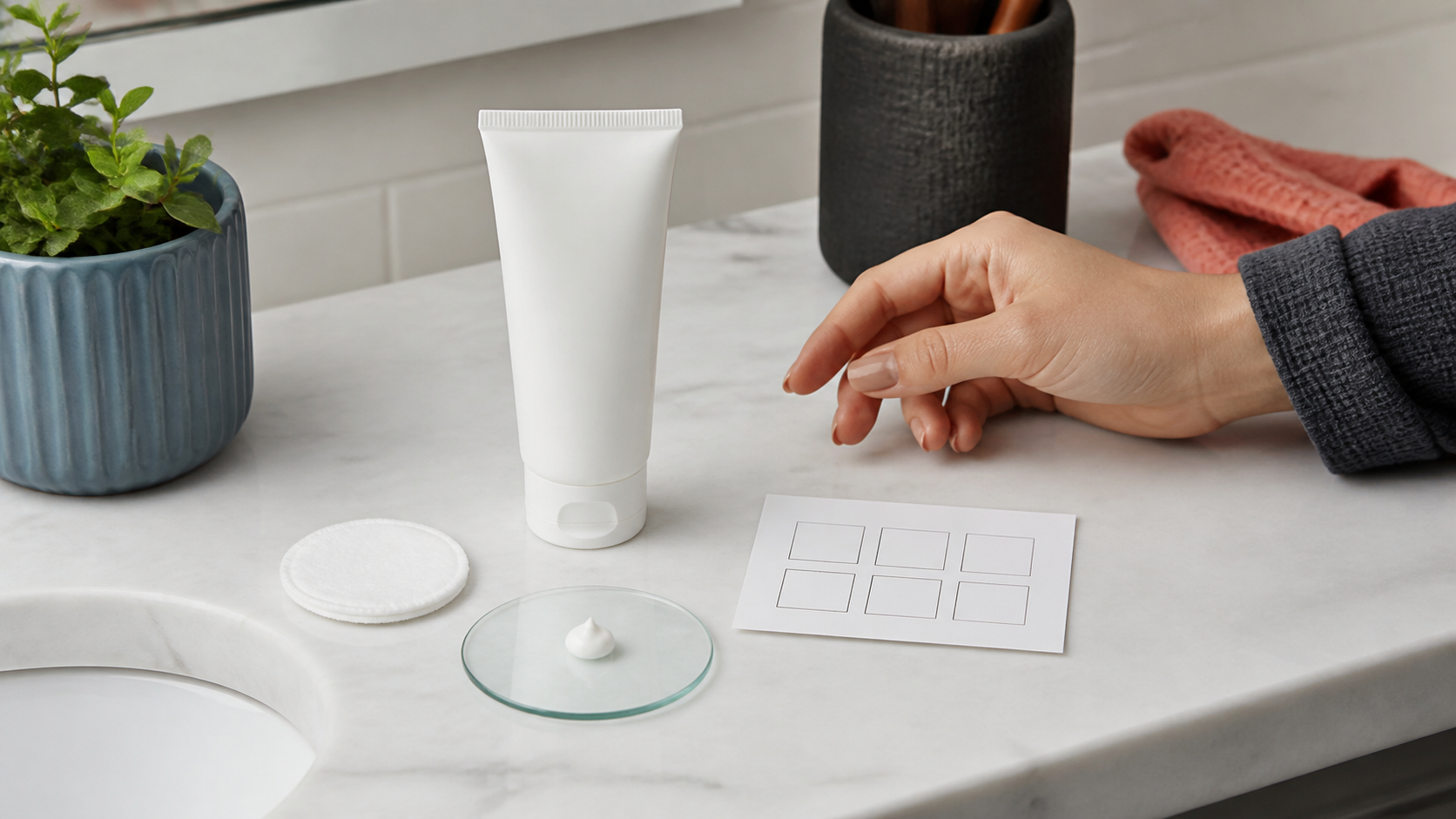
How to patch test a new moisturizer
- Choose a small area along the jaw or behind the ear.
- Apply a small amount to clean, dry skin.
- Repeat according to the product directions for several days.
- Watch for itching, swelling, persistent redness, or a rash.
- Patch testing lowers uncertainty, but it cannot guarantee that full-face use will be reaction-free.
Introduce only one new product at a time. When three products arrive on the same day, it becomes nearly impossible to know which one caused the problem.
What to look for in a replacement
- A clear job: plain hydration and moisture, not exfoliation plus brightening plus acne treatment.
- A familiar texture: gel cream for light comfort or a cream for stronger dryness support.
- Fragrance-free labeling: especially if scented products often bother you.
- Supportive ingredients: glycerin, panthenol, ceramides, squalane, dimethicone, or petrolatum can all be useful depending on the formula.
- Packaging you can keep clean: a pump or tube is convenient, though a jar can also work with clean hands.
Texture matters too. Our gel cream vs. ceramide cream comparison helps match a moisturizer to dehydration, oiliness, and climate without assuming thicker is always better.
When to get help
Seek urgent help for breathing difficulty or rapidly developing swelling. Contact a healthcare professional for significant eye or lip involvement, blistering, severe pain, a spreading rash, signs of infection, or symptoms that keep returning. A dermatologist can also arrange patch testing when allergic contact dermatitis is suspected.
The bottom line
A stinging moisturizer is information, not a challenge. Stop, simplify, and look at the whole routine. Often the answer is less dramatic than finding one “bad” ingredient: the skin was already overworked, the active steps stacked up, or the formula had more jobs than its name suggested.
Once your skin feels normal again, add products back one at a time. That slower approach is not exciting, but it is how you learn what your skin actually tolerates.